Inside the V125 solenoid valve

This time, I would like to digress from CT business to solve a problem with my address V125G (CF46A), which is very active in daily commuting and shopping.

1


Idling became unstable and I thought the insulator was damaged as promised, but when I checked it, there was no damage.
Then I thought it might be a solenoid valve, and when I looked at it, there was no valve rebound.
2


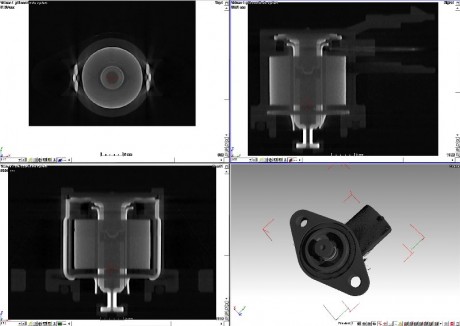
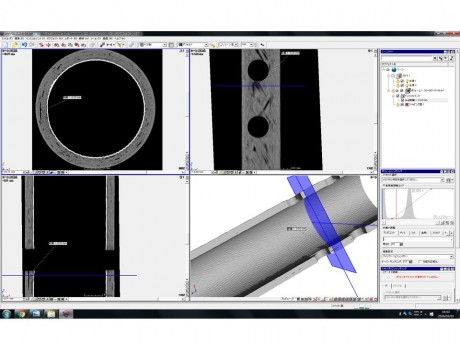
I made a 3D model after taking a CT scan to try, but could not get a good image to confirm the spring.
X-rays are not good for heavy metals such as iron and copper, and electromagnetic coils and magnets are not good for them because they are like lumps of metal.
A spring by itself is OK, but a small mass in a large mass is difficult to visualize.
3


When performing CT imaging, a test scan is taken for positioning.
The fluoroscopic image accompanies the test shot, so I looked at the image at that time.
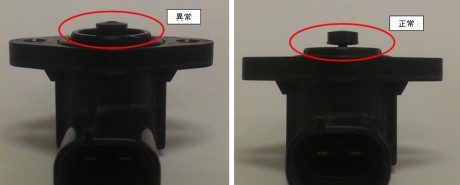
I noticed something wrong with the red circle section.
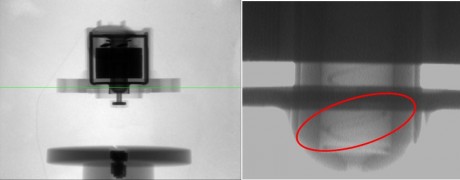
4


I disassembled the valve section and found that one coil spring was broken.
This seems to be causing the idling malfunction due to lack of tension.
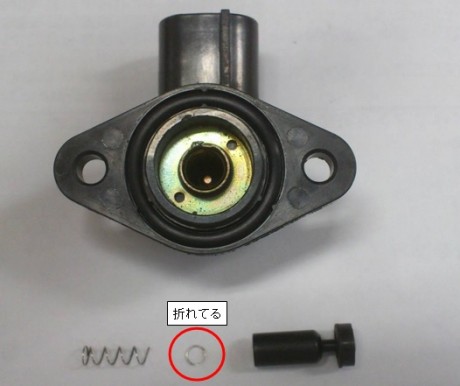
5


So when I was thinking about replacing the springs, I noticed a parts cleaner nozzle.
I put it in the valve and it fits perfectly.
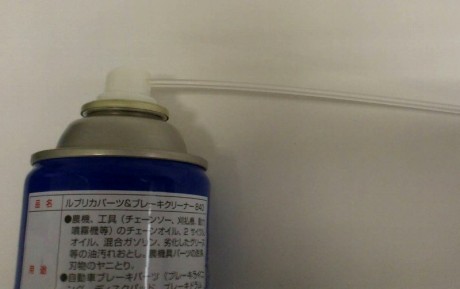
6


I cut about 2 mm off and assembled it as a clog substitute for the valve.
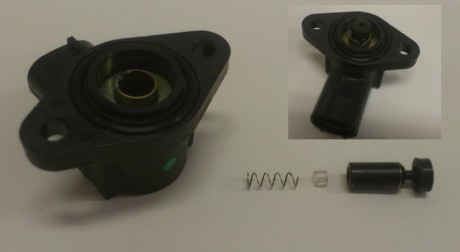
7


After installation, it has been in use for 2 months with no problems.
Genuine parts cost a little over 4,000 yen. Whether you consider this expensive or inexpensive is up to you.

Try it at your own risk.  See you soon....


What are X-rays?

Hello, this is Webmaster. Well, we are working with X-ray CT.

What is an X-ray and what is an X-ray CT?

Now, here is the simplest page I know of that explains how X-rays and CTs work.

http://logmi.jp/82721

(Logme's page)

In the above page, the person is fixed and the detector is rotating, but in our related CTs that handle non-living things, the object being imaged is the one that rotates. Although it is very difficult to rotate the detector, it is not possible to rotate a human being at high speed, so CT for medical use is designed to rotate the detector.

There are other differences between medical CTs and our industrial CTs, but I will write about them another time.

X-ray CT internal observation

Hello, RPV.

The image below is an example of internal observation using an X-ray CT scanner.

It broke the other day and I scanned it at CT for reference and found internal gaps scattered throughout.

wind

It is a tool called a universal extension with a shaft made of carbon and used for windsurfing.

The scanned product is the lower product in the image below.

P3030002

The upper product was actually broken and the broken part was considered to be unobservable because of the rust.

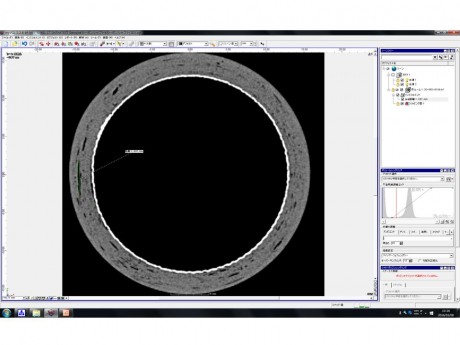
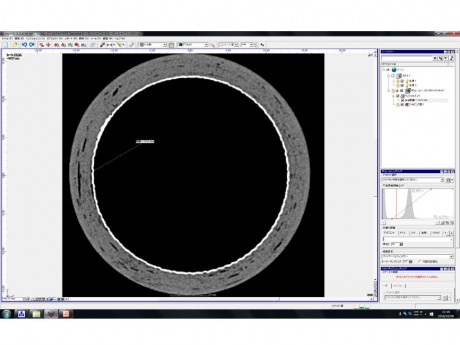
The gap was 0.3mm in the longitudinal direction at about 4mm when measured with the dimensional measurement function.

universal

Universal 2

I don't know if this gap is good or bad, but as a user I would appreciate it more if it were not there.

We hope this will be helpful to you.